Technology Overview Produce Water from Air powered by Solar Heat | Water from Air
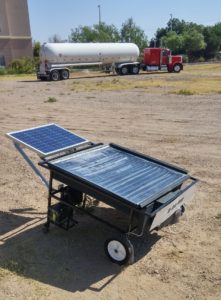
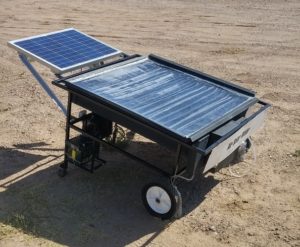 AirSolarWater system produces pure water from air using only solar energy.
AirSolarWater technology is patented in the USA with international patents granted. Both the A2WH and Grow Dryland product lines are covered by these patents.
AirSolarWater is a solar powered atmospheric water generator device (AWG) that are also known as water maker devices (WM) and Water Air Extraction Devices (WAED). AirSolarWater is not a fog or dew capture system and uses a completely different process that allows it to work in a wide range of climates even dry deserts while producing the most water during hot summer days when most AWG struggle.
AirSolarWater operates independent of the electric grid and does not require refrigeration pumps. AirSolarWater provides a superior investment because it does not consume the large amounts of electricity or fuel needed by other AWG and includes all the required solar collectors as part of the base price.
- Deliver water so no woman or child has to walk miles to obtain water.
- Eliminate the need for massive distribution infrastructure to deliver safe water.
- Provide Water for During Emergencies when power fails.
- Deliver safe water in locations where municipal supplies fail
- Supply very clean potable water in locations where municipal supplies are unsafe.
- Provide water to grow edible trees in remote, dry and hostile locations.
- Provide water for sheep, cattle and other livestock.
- Provide mini Oasis to attract wildlife.
- Deliver water to preserve declining species during drought.
- Reverse Desertification
- Sequester massive amounts of Carbon while providing fuel source for sustainable bio-fuel.
- Reduce or eliminate drought caused famine.
- Eliminate water scarcity caused migration, the associated refugee crisis and related wars and humanitarian disaster.
The A2WH system uses a salt desiccant to absorb moisture from the air. The higher the humidity the more water our desiccant can absorb which increases production by reducing the required heat the next day. AirSolarWater is quite robust and will work in most locations including most deserts because it absorbs water from the air during the cold of the night when relatively humidity rises. Even locations with low daytime humidifies under 20% will have sufficient cooling at night to allow the process to operate effectively. Unlike most water makers that are required to chill massive amounts of air which requires them consume lots of expensive of electricity we use chemistry and careful design to allow our salt to absorb the water using only a small blower to circulate night air over the salt. Order Now
AirSolarWater technology uses Solar heat for the primary energy source with a small amount of electricity to run the sensors and fans. We use solar energy to provide heat during the regeneration process which extracts the moisture from the desiccant and allows us to capture the water in liquid form. The required electricity is supplied by the included solar panel and a battery. A sophisticated micro controller sensor system determines when to switch between absorption and regeneration modes. The controller allows the system to automatically adapt to changing climate conditions as seasons change or when the system is moved to different locations.
AirSolarWater can save over 2 kWh of electricity per gallon of water produced compared to common grid powered water makers. The US government indicates that each Kwh of electricity emits 1.22 to 2.16 pounds of carbon depending on the fuel used to generate the electricity. Each gallon of water produced by AirSolarWater can reduce carbon emissions by at least 2.44 pounds. For a system that produces 5,000 gallons a year this can save over 12,000 pounds of carbon or over 240,000 pounds over a 20 year system life. In an era when global climate change appears linked to increasing water scarcity it makes sense to avoid emitting carbon to deliver water.
Joe Note: Insurance underwriters and commercial bankers should be pursuing massive deployment of AirSolarWater in lieu of carbon emitting water sources because the reduction in coastal flooding could more than pay for the AirSolarWater systems.
The AirSolarWater system Process:
- Absorbs moisture into a salt at night when humidity is relatively high
- Converts water absorbed the prior night into liquid water the next day using solar heat.
- Humidity Enriched vapor is baked out of salt using solar heat.
- Condensing occurs at near ambient and does not require refrigeration pumps.
- Optional Air filters are used to filter the air before the absorption
- A small amount of electricity to operate blowers, sensors and controller are supplied by built in PV panel
- At night a battery uses energy stored during day to run absorption fan.
AirSolarWater was designed for sunny locations and it requires sun to operate. It will produce less water during the winter or periods with heavy cloud cover.
 or 206-601-2985
Video Process Overview
Video showing water produced by AirSolarWater
Production varies by location. We designed AirSolarWater to produce the most water during the hottest sunniest day of the hottest summer month when water is most needed, the trade-off is that it produces less water when there is less sun or the sun is weaker. The 1/2 gallon estimate is based on a sunny day June – August in climate similar to Atlanta Georgia, Hawaii or Key West, FL. The system is solar limited so on days with lots of clouds, during the winter or if shaded from direct sun production will be less. We designed for a nighttime humidity above 65% during the coldest part of the night. The system will continue to work with lower nighttime humidity but the production will drop sharply when humidity drops below 50% during the coldest part of the night. Humidity rises at night as the temperature drops so most locations can provide humidity above 50% at night most of the time. We can modify the system to work with nighttime humidity as low as 20% but it does increase the cost.
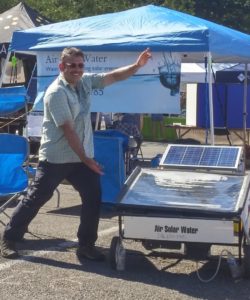
Producing water where it is needed:
Imagine the ability to deliver safe drinking water in places where there is no power, no safe ground water, no available surface water and no viable rain capture. Imagine doing this where there isn’t even any salt water or where the salt water is too contaminated to allow effective treatment.
Every day solar heat cycles 1,356 cubic kilometers (358 trillion gallons) of water through the atmosphere. A portion of this blows over land where our AWG units can capture it and turn it back into fresh, pure liquid water usable for drinking, cooking and crops. Our A2WH units can do this in the hottest deserts and in fact run best in hot sunny locations where water is needed the worst. We do not need rain, fog or any other form of precipitation.
Our A2WH design has few moving parts which are easily serviced and can use low grade heat from simple solar collectors. This systems unique design makes it environmentally friendly and suitable for cost effective scaling from small household models through industrial and institutional systems producing many million gallons per day.
 Water is essential
Water is essential for human life. We drink it and use it for our crops. Water is already scarce and becoming ever more valuable. In fact the UN has predicted wars over access to fresh water. Shortages of water in California have already caused more than 100,000 acres of farmland to lie fallow as a result of the 2008 drought.
Over 70% of earths surface is covered with water but very little of this water is useful for humans to drink or grow crops. 97% of all water is saline contained in the oceans which leaves only 3% as freshwater. 70% of the freshwater is locked up in ice leaving 22% as ground water and surface water. Ultimately less than 1% .of the world total is represented in lakes, rivers and wetlands.
Adequate water is essential for economic and political growth and stability. Our technology is specifically designed to deliver water in locations where unsafe or insufficient water is available. It was invented to allow continued development in areas where all other water sources have been exhausted or are fully allocated.
Ultimately we hope to see our water from air technology used to reverse desertification by providing sufficient water to establish green zones in the deserts. This will ultimately reduce food insecurity, reduce the risk of drought induced famine and reduce the poverty induced when people are forced to scavenge on a day to day basis just to obtain enough water to meet their basic needs.
Our difference from common AWG units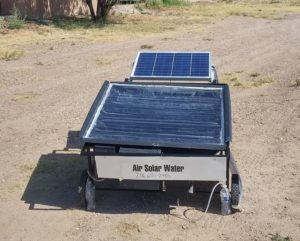
- Low Energy consumption
- Entirely powered by renewable energy
- Easy to scale from very small to very large water supplies.
- Inherently clean prices delivers very clean water even before filters are added.
- Includes all needed components
- Rapid assembly and water production with minimal effort.
- Delivers most water during hottest part of the summer even in dry locations
- Consumes no grid electricity or fuel.
- Easy to assemble large arrays of units to deliver large amounts of water.
- Requires no refrigerants.
- Easy to service and replace all moving parts.
- Highly reliable array provides massive redundancy and great fault tolerance.
- Easily adapted for local / region production to minimize fabrication costs.
Most Air to water systems use refrigeration to chill air to the dew point that means that as the dew point drops the more the unit must do more work to sufficiently chill the air. This causes them to use large amounts of electricity. It is fairly common for electric units to consume of 2.2Kwh per gallon produced which gives them a high variable operating costs which can exceed 40 cents per gallon.
We designed A2WH units to operate entirely from solar energy. This is mostly solar heat with a small amount of solar electricity used to operate valves, sensors and the electronic control system. This allows our system to operate much more efficiently which is especially important in areas where electricity is expensive such as islands where electricity is generated using imported fuels.
Most AWG systems are built around a refrigeration system which is very similar to that used in small electric air conditioners. The best units consume 600 to over 3,000 watt hours per gallon of water they produce. The industry average trends show consumption over 2,2000 watt hours per gallon which rise rapidly as humidity drops.
A2WH functions with no external electricity. This saves 3,000 watts per gallon. Our novel design and control system allows it to efficiently extract water in a wide range of conditions including conditions where electric AWG units become inefficient or do not work at all.
Real world feedback
We recently received a letter from a man who has a 40 acre ranch in a remote part of Arizona. He purchased an electric refrigeration unit. After investing $29,000 in solar panels and batteries his unit still doesn’t work when the humidity drops below 48% RH and still does not deliver the rated production.
Our units can reduce carbon emissions by over 5 pounds of carbon per gallon produced as compared to grid powered electric systems. (2.2 pounds carbon per KWh saved * 3000 watts per gallon = 6.4 pounds of carbon per gallon of water). Even a small 6 gallon per day system this adds up to nearly 11,000 pounds reduced carbon emissions per year.
Our system uses solar thermal heat to harvest water from air even when the air has low humidity. Unlike radiant condensation systems this system actually produces during the dry months even when there is no dew and it’s production can go up in windy locations which can prevent radiant chilling systems from working at all. Our technology can work in conditions where the dew point is far below the chilling level delivered by radiant chilling panels.
Our most important difference is the compatibility of the core design for scaling efficiently into millions of gallons per day at a reasonable cost. It’s other major benefit is compatibility with remote areas where grid power is either unavailable or expensive. In some areas our units can be installed in mountains outside of towns and provide both water pressure and electricity for the town. Rather than exaggerate summer power shortages our system can actually help reduce these shortages.
The US patent number is 8,506,675
The AU patent is number is 2011230503
Links
- Reduce financial impact of drought for cattle ranching and sheep ranching
- Usage Overview
- Device Overview
- Prototype Advertisement for Retails Sales
- FAQ
- Project Planning and Preparation
- Apply in Atlanta GA.
- A2WH Clean Tech / Green Biz Company and Product Brief
- The Water Cycle: Water Storage in the Atmosphere
- Conservation and the water cycle
- Reference
