Grow Dryland Provides Water to Start Trees on desert land
The Air Solar Water grow Dryland Unit is a highly effective way for farmers to get water to their trees. Farmers can now turn abandoned dried-out parcels into prosperous orchards or cattle feeding trees. Using our unit it will be easier for trees to grow deep roots in order for trees to survive the drought.
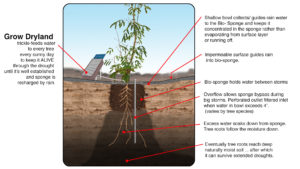
The Grow dryland process allows a small device to supply the water to keep seedlings alive where they would otherwise die of thirst
Grow Dryland uses a complete planting process which is combined with our patented technology, when fully implemented can provide for tree species that could normally not survive without auxiliary water to survive and thrive on the parcel. The most common uses and benefits provided by our technology are:
- Growing trees for shade
- Growing trees in the desert for wind blocking
- Starting trees when you have no irrigation water
- No need to carry water in for daily needs
- Runs entirely from solar energy, no grid or generator needed
- Completely renewable, everlasting source of water from air
- Can help recharge groundwater using our micro-capture process
- Can help trees roots discover deep soil moisture they may never have found
- Making desert parcels use able
- Plants tree in dry and hot climates
- Provided crops water during drought seasons
- Desert cultivation
- How A2WH Grow Dryland process can be used to reverse desertification while mitigating a 1.5 trillion dollar risk for EU governments
- desertification.html
Grow Dryland by A2WH supports starting trees on dry desert land where there is no irrigation.
Grow trees in the dry desert during the worst drought details
To order call 206-601-2985
Why Grow Dryland and Trees
Grow Dryland was invented to reverse desertification worldwide. It is part of a larger program designed to revitalize large areas of degraded and desertified land. This plan centers around starting profitable trees because:
- Trees can act as the anchor for a recovery oasis
- Trees can provide biomass for compost, animal food and fuel in the short term while delivering a valuable lumber product in the long term
- Drought tolerant trees and our planting process can produce valuable foliage during drought conditions when other food sources are drastically reduced
- Trees are ideally suited to take advantage of our micro catchment and the water from “Grow Dryland” in a way that annual crops simply can not match. This allows us to support a crop on land that simply could not support traditional agriculture.
- We can start trees using this process during the worst drought and still deliver high survival rates
- This kind of planting can rehabilitate the land without increasing groundwater demand. Demonstrating the ability to deliver a profitable crop without drawing groundwater is critical in many parts of India, Mexico, Pakistan, Texas, Oklahoma and California where over pumping of ground water is causing well levels to drop. This is especially true in Mexico and India where groundwater levels have already dropped to levels where traditional farming techniques are failing due to lack or water or increased costs to obtain the water.
- It will be most beneficial in areas with low rainfall or common drought where other approaches have failed.
- Improved water retention and micro-catchment when deployed in large scale can help restore groundwater levels in degraded areas which can accelerate the restoration and revitalization of degraded land.
- Fodder trees provide an alternative animal feed that can allow local farmers to reduce their demands on natural grasses and allow those lands to start the recovery process.
- The foliage and compost from high nitrogen species such as Albizia Lebbeck and Red Alder can be added to soil of traditional fields which can improve yields as a natural fertilizer. They can also increase water retention which can increase food availability especially during drought years.
Our assertion is that we need people living in desertified areas to plant, maintain and protect the trees needed to revitalize the land. To gain their enthusiastic support they need to gain local benefits, income or food from those trees. We focus on strategies synergistic with the needs of local farmers and local villagers who we believe will make the best long term stewards. All plans require money to get started but unlike many approaches our plan can deliver a profit so it is not entirely dependent on charity or government funding.

drops forming on interior of the Grow Dryland skin
Grow Dryland supports starting trees in areas where seedlings would normally die of thirst. When combined with our full planting system Grow Dryland can support growing tree species in the deep desert which would normally be unable to survive at that location and it can do this without pumping groundwater and without water delivery.
Our Solar powered Grow Dryland extracts water from the air which is delivered directly to the seedlings roots and can keep the seedling alive in locations where they would normally die from dehydration. The tree uses this water as it grows deeper roots that can allow it access soil moisture deeper underground and eventually survive without auxiliary water.
Grow Dryland is ideal if you want to start trees in areas where trees can survive once they are large enough but the seedlings would die from dehydration before their roots can reach the deeper moist soil. When combined with our larger planting system Grow Dryland can even support trees in dry and barren desert locations.
Air Solar Water technology can reliably produce water in areas where there is little or no rain; in fact it will deliver the most water during the hottest, sunny and dry parts of the year, which is when fragile seedlings need the most water. Other water storage and dew harvest devices may not have any water left during the critical part of the year when Air Solar Water is delivering the most water. Since Grow Dryland produces water directly from the air and since it’s production rises during the summer months it is completely immune to drought. The benefits of that are:
- Extracts water from the air and uses that water to keep seedlings alive in desert conditions where water and electricity are not available.
- Powered entirely by solar energy which makes it ideal for remote and hard to access locations.
- Eliminates the need to drag a hose or a bucket to every tree to provide water.
- Makes it feasible to plant trees in areas where you can not visit regularly to provide water.
- Delivers about 2 ounces of water per summer day directly to trees roots via a wick or tube.
- Support Trees in locations where it is not feasible.
- Dramatically increase the survival rate of the trees.
- Start trees along perimeter property lines without a massive effort to install a drip irrigation system.
- Each Grow Dryland can start many trees over its useful life.
- When combined with wicking drill techniques Grow Dryland can guide seedling roots into deeper subsurface moisture so it can thrive even in the dry desert.
When used with a wick system, the water collected by the Air Solar Water unit can guide the seedlings roots deep below the surface where soil moisture is sufficient for the tree to continue to develop and thrive. Once the plant is large enough to grow on its own the Grow Dryland can be moved to support a new seedling. When combined with a bio-sponge and land profiling techniques the Air Solar Water unit can support tree seedlings in the most hostile and desolate conditions.
Grow Dryland is not a fog capture system and uses entirely different physics with most of the working energy being provided in the form of solar heat. Grow Dryland works well in dry desert conditions without supplemental water. Grow Dryland will deliver the most water during the hottest summer day when many other AWG (Atmospheric water generator) technologies fail.
Where to use Grow Dryland:
- Start trees to provide wind screens where irrigation is unavailable.
- Start trees for shade and fuel at remote locations like camping and recreation lots where there is no water available.
- Start perimeter privacy and wind screen trees on larger lots where Grow Dryland may be easier and less expensive than installing large irrigation systems.
- Start forage trees restore grazing lands and provide drought resistant alternate food source.
- Start trees to provide habitat and shelter to attract wildlife to barren desert lots.
- Start the process of revitalizing degraded and desertified lands by starting trees that can hold moisture in the soil, reduce erosion, reduce runoff, reduce dust loads, provide habitat and aid in returning the land to healthy state.
- Support growth of plants in areas where municipal watering restrictions would prohibit the same plant.
- Establish high nitrogen biomass trees on cheaper land where no irrigation rights are available. The foliage can be used to produce traditional biomass for fuel or used to produce high nitrogen compost.
- Produce income from desert land without increasing demand on groundwater.
Grow Dryland is best combined with the rest of our planting process which can help grow trees in the most hostile hot and dry locations. Many locations only need a small portion of the planting process. Our goal is to provide the technology and process that will allow high survival rates in the most challenging conditions.
- Wicking root Drill guides roots to naturally available water where they may never have otherwise reached.
- Bio-Sponge Stores water from rainfall so the tree has a local reserve while providing naturally decomposing nutrition.
- Micro Land profiling Guides water to the Bio-sponge for storage, reduces evaporative losses and helps eliminate soil erosion.
- Food and Foliage Reduces drought related food famine.
- Nitrogen rich compost The nitrogen rich leaves can be composted for nutritional fertilizer that holds moisture.
We fabricate these units as we receive orders in our facility near Seattle Washington. We test every unit before shipping and it can take a few weeks to work through the full process. Each unit contains the main Air Solar Water Grow Dryland device which unlike our competitors includes the solar electric panel and battery needed to allow it to operate. The user must supply the local planting supplies and the wick if desired.

Pictures of Grow Dryland desert tree watering device for plant watering, drought watering, desert tree starting, green wall watering, desert watering, tree irrigation, Dryland farming, Dryland irrigation and Dryland watering.
